What exactly does a parcel hold?
Native BOT on BOT Chain plus an optional note of up to 120 characters. The amount must be greater than 0 BOT and the recipient must be a non-zero address. No other tokens are supported.
 Pigeonhole
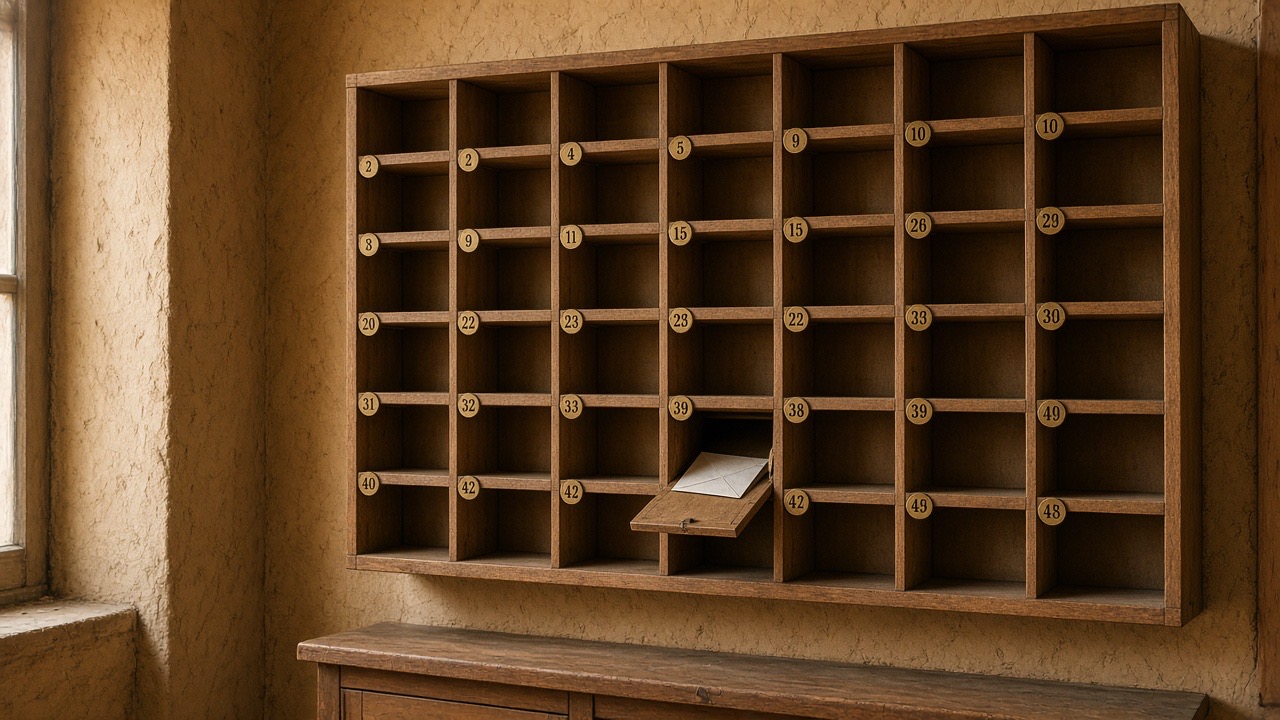
Sorting room · twelve specimen fills
Anyone who wants to hand BOT to a specific person without making it a public giveaway. A first payment to a new collaborator, a small thank-you to a friend's fresh wallet, a refund to a buyer whose address you only have as a string of characters.
It also suits people who want a short note to travel with the money: a reason, an invoice reference, a line of thanks. And it suits cautious senders — if the note goes to the wrong place or is never collected, the recall path returns the BOT instead of leaving it stranded.
Because the named recipient is the only one who can open, a pigeonhole is a poor fit for open claims and a good fit for one-to-one handoffs.
A plain transfer is final the moment you send it. If the address is wrong, or the person never claims it, the BOT sits with a stranger. A pigeonhole keeps the money sealed until the named recipient acts, and keeps the sender able to take it back while the slot is still closed.
The slot is also quiet. It is not a public noticeboard and not a two-sided deal desk: there is no counter-offer, no negotiation, no listing to browse. You choose one address, write a short note, and the parcel waits. The sorting room shows slot numbers and amounts, not a classified ad for anyone to claim.
Nothing is pooled and no operator sits in the middle. The contract holds each parcel's BOT until exactly one of two things happens: the recipient opens it, or the sender recalls it.
Native BOT on BOT Chain plus an optional note of up to 120 characters. The amount must be greater than 0 BOT and the recipient must be a non-zero address. No other tokens are supported.
They call open(id) from the address the parcel was addressed to. If the parcel has not been recalled, the sealed BOT pays directly to them and the slot closes for good.
Call recall(id) from the sending address while the parcel is still unopened. The sealed BOT returns to you and the parcel can no longer be opened by anyone.
Only if they addressed it to their own wallet. Otherwise the open action belongs to the named recipient alone.
There is no fee; you send native BOT and the full amount is sealed in the slot. The deployer has no path to redirect or collect a parcel, and there is no owner withdraw of other people's parcels.
BOT Chain mainnet, chain id 677, with BOT as the native token. You can check contract activity on the explorer at https://scan.botchain.ai.
Pick one address, seal some BOT with a short note, and let the parcel wait in its numbered slot. If they open it, the BOT is theirs; if they never do, recall it and the BOT returns to you.
Back to the wall